


Struggling with multiple debt payments? You might wonder if debt consolidation makes sense. The answer isn’t simple. Companies like Freedom Debt Relief have helped resolve over $20 billion in outstanding debts since 2002, but this strategy doesn’t guarantee savings for everyone.
Let’s look at the complete picture of debt consolidation’s pros and cons. A lower interest rate might seem attractive, but savings aren’t guaranteed long-term. Here’s a practical example: With $9,000 in total debt at a combined APR of 25%, consolidation could save you $820 in interest over two years. The catch? Origination fees typically cost 1% to 6% of your loan amount, and balance transfer fees range from 3% to 5%. These fees could eat into your potential savings.
Let’s explore whether debt consolidation makes sense by looking at its benefits and the drawbacks that banks rarely mention. You’ll learn about consolidation options like personal loans, balance transfer credit cards, and HELOCs. This information will help you decide if debt consolidation fits your financial situation.
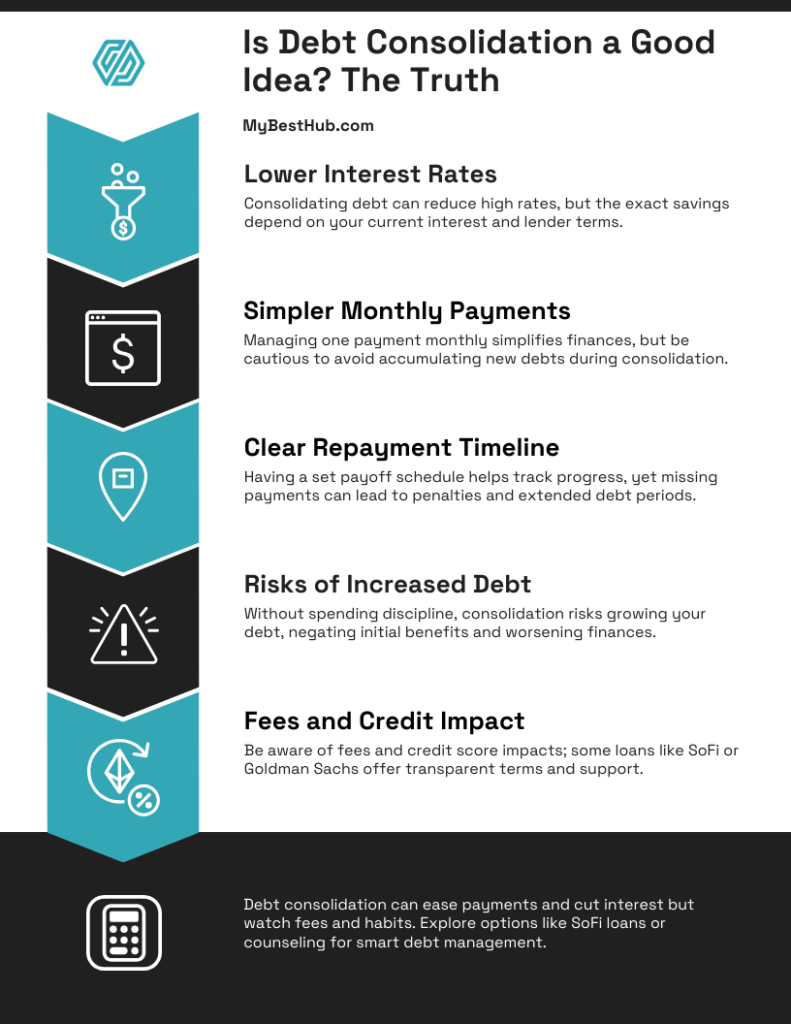
Is Debt Consolidation a Good Idea? The Core Benefits
Debt consolidation stands out as one of the most powerful tools that simplifies financial obligations and reduces overall costs. Is debt consolidation a good idea? Let’s get into the core benefits that make it worth thinking over.
Fewer monthly payments to manage
Multiple due dates, various payment portals, and different minimum amounts can feel overwhelming. A single, manageable monthly payment replaces this chaos through debt consolidation.
You won’t need to track five, ten, or even more separate bills because consolidation helps you focus on just one payment. This simplification goes beyond convenience and creates genuine peace of mind. Your household budget becomes easier to manage with fewer accounts to track. The mental energy you save by making only one payment monthly might be reason enough to think over consolidation.
This simplified approach prevents missed payments that could harm your credit and trigger late fees. Setting up auto-pay becomes easier with just one payment date, which reduces the risk of missing payment deadlines.
Potential for lower interest rates
Lower interest rates make debt consolidation a compelling choice. Borrowers with good credit can save substantial amounts on interest.
To name just one example: A consolidation loan with an 11% APR and 12-month term could save you $455 if you owe $4,000 on a credit card with 19% APR and $5,000 on another card with 18% APR. Balance transfer cards might offer 0% introductory APRs for periods ranging from 12 to 21 months.
Beyond that, your payment reduces the principal balance more each month when you pay less interest. This change can dramatically improve your overall financial picture.
Faster debt payoff timeline
Debt consolidation provides a fixed repayment schedule with a defined end date, unlike minimum credit card payments that can keep you in debt for decades. You get a clear path to becoming debt-free with this structured approach.
Lower interest rates combined with fixed payments help you eliminate debt faster. Seeing progress toward a specific payoff date motivates borrowers to stick with their repayment plan.
Most consolidation loans offer terms between three and five years – a reasonable timeframe for becoming debt-free. A survey showed that 88% of debt consolidation customers expected to pay off existing debt sooner with their consolidation loan.
Improved credit score with on-time payments
Your credit profile benefits from debt consolidation in multiple ways. We primarily build a positive payment history through consistent, on-time payments on consolidation loans – the most influential factor in credit score calculations.
Your credit utilization ratio drops by a lot when you pay off credit cards through consolidation. Credit experts suggest keeping utilization below 30% of available limits. Your total credit limit of $15,000 means maintaining balances below $4,500.
Your credit mix improves when you convert revolving debt like credit cards into installment debt through consolidation, which affects 10% of your FICO score. This diversification shows you know how to manage different types of credit responsibly.
These advantages raise the question: is debt consolidation a good idea for you? Your specific financial situation and habits will determine the answer.
The Disadvantages of Debt Consolidation You Should Know
Debt consolidation might look great on paper, but you need to know about the potential risks before you make your move. Let’s get into the downsides that could affect whether is debt consolidation a good idea for you.
Upfront fees and hidden costs
Those simple payments you’re promised come with fees that can eat into your savings. Most debt consolidation loans tack on origination fees of 1% to 10% of what you borrow. If you’re thinking about balance transfer cards, expect to pay transfer fees between 3% and 5% of your balance.
The charges you might face include:
- Annual fees on new credit accounts
- Balance transfer fees (typically 3-5%)
- Closing costs (for home equity loans)
- Loan origination fees (1-10% of loan amount)
- Prepayment penalties
- Late payment fees ($25-$50 per missed payment)
These expenses add up fast and might wipe out any interest savings you hoped to get. Make sure to run the numbers and see if these fees are worth the lower interest rates.
Risk of higher interest rates
Those attractive low-interest rates you see advertised? Not everyone gets them. Your credit score is what makes or breaks your new interest rate.
A lower credit score means lenders see you as risky, and you might end up paying more interest than you do now. It also doesn’t help that stretching out your loan term for smaller monthly payments could mean paying way more interest over time.
Balance transfers show this perfectly. The 0% promotional rate looks great, but you’ll pay a 3-5% transfer fee upfront. Once that promo period ends, the interest rate jumps way up. You might end up paying more than your original debt.
Temptation to accumulate more debt
The psychology of debt consolidation can trip you up. People often feel a false sense of relief when they see zero balances on their credit cards.
This feeling leads many people right back into trouble. One bank puts it well: “After consolidating, you might feel like you have more financial breathing room and be tempted to spend more”. If you don’t fix your spending habits, you could pile new debt on top of your consolidation loan.
Picture this: you consolidate your debt and start using your cards again for what seems like small purchases. Next thing you know, you’re $3,000 deeper in credit card debt. Now you’re worse off than when you started.
Missed payments can hurt your credit
Just because you’ve consolidated doesn’t mean you’re in the clear, especially if the new payment schedule is tough to handle. Missing just one payment on your consolidation loan can tank your credit score.
Your score might also take a hit from:
- Hard credit inquiries during application
- New credit accounts that lower your accounts’ average age
- Higher credit utilization with balance transfer cards
Consolidation might make your payments simpler, but it doesn’t fix what got you into debt. Without better money habits and clear goals, you could find yourself back at square one—or even deeper in debt.
These drawbacks should help you figure out if debt consolidation fits your money situation and goals.
Types of Debt Consolidation Options
The path to financial freedom through debt consolidation depends on choosing options that match your financial situation. People often ask is debt consolidation a good idea. The answer lies in understanding the choices you have.
Personal loans
Personal loans give you quick access to money without putting up any collateral. Most borrowers can get these loans. You can borrow between $7,000 and $50,000 and pay it back over 3-6 years.
These loans work simply. You get all the money at once to clear your existing debts. Then you just make one fixed payment each month until you’re done. People with good credit scores can get interest rates that are by a lot lower than credit cards, which saves money over time.
In spite of that, you might need to pay origination fees between 1% and 10%, which could eat into your savings. Your credit score matters too – if it’s low, you might end up paying interest rates as high as 36%.
Balance transfer credit cards
These cards let you move your credit card balances to a new card with 0% APR for 15 to 21 months. This break from interest payments helps you make real progress on paying down what you owe.
You’ll pay a fee of 3% to 5% of the amount you transfer. On top of that, these cards work best if you can pay off smaller debts during the no-interest period. After that, the regular interest rates might be just as high or higher than your old cards.
Home equity loans and HELOCs
Home equity options use your property’s value to get lower interest rates than unsecured debt. A home equity line of credit (HELOC) usually charges 7.5-8.5% APR, which can save you lots of money.
To cite an instance, see what happens when you move $15,500 of credit card debt at 28% APR and $25,525 of personal loan debt at 14% APR to a HELOC at 8% APR. You could save about $4,671.50 each year in interest.
Of course, putting up your home as collateral comes with big risks – you could lose it if you can’t make payments. Lenders usually want you to keep at least 20% equity in your home after taking the loan.
401(k) loans
These loans let you borrow from your retirement savings without any credit checks. You can borrow up to 50% of your vested balance or $50,000, whichever is less, and pay it back within 5 years.
The interest you pay goes right back into your account – you’re basically paying yourself. But if you default and you’re under 59½, you’ll face taxes and a 10% penalty.
Debt management plans
Debt management plans (DMPs) work differently from loans. Nonprofit credit counseling agencies run these structured repayment programs. They can cut interest rates to 0-10% and might reduce your total credit card payments by half.
Most people complete DMPs in 3-5 years, and they come with ongoing money management education. You’ll pay around $25 monthly, though fees can go up to $79 depending on your state.
How to Know If Debt Consolidation Is Right for You
Making a decision about debt consolidation needs a good look at your financial situation. Let’s explore what helps determine if is debt consolidation a good idea for your specific circumstances.
Review your credit score and financial habits
Your credit score is vital to the debt consolidation equation. Lenders usually require a score of at least 650 to offer favorable terms. People with scores above 700 often get the best interest rates. Those below 670 might face higher rates or fewer options.
Numbers tell only part of the story – take an honest look at your spending patterns. Consolidation won’t fix why it happens if overspending on optional items created your debt. This solution works best when you’ve already started your debt-payoff experience and see it as a tool rather than a quick fix.
Compare interest rates and loan terms
Figuring out your potential savings is significant. Add up your current debts and find their weighted interest rate. This becomes your way to measure – any consolidation option should give you a lower rate to make sense.
Look at rates from at least three different lenders. Note that origination fees (1-10% of loan amount) and other costs matter when you compare total repayment amounts. A loan with a slightly higher interest rate but no fees could save you more than one with a lower rate but big upfront costs.
Understand your debt-to-income ratio
Your debt-to-income (DTI) ratio affects your consolidation options directly. You can calculate it by dividing your total monthly debt payments by your gross monthly income, then multiplying by 100. Here’s an example:
Monthly debt payments: $1,500 Gross monthly income: $5,000 DTI = 30%
Most lenders want DTI ratios below 36%, and 43% is often the highest acceptable limit. Higher ratios might limit your choices or lead to less favorable terms.
Ask: Should I consolidate my debt?
The answer to “should I consolidate my debt” comes down to honest self-assessment. Consolidation could be right if:
- You have multiple high-interest debts
- Your credit score has improved since getting your original loans
- Your debt is less than 40% of your gross income
- You’ll avoid new debt while paying off what you owe
You might want to think twice if you don’t have stable income, haven’t fixed spending habits that created the debt, or would only save a small amount after fees.
How to Consolidate Debt the Smart Way
A debt consolidation plan needs a smart approach. You should first figure out if is debt consolidation a good idea for your situation, and then follow these steps to make your plan work.
Step 1: List all your debts
Start by creating a detailed list of all your debts with outstanding balances, interest rates, and monthly payments. This clear overview shows exactly how much you need to combine and helps you calculate your debt-to-income ratio.
Step 2: Shop for the best consolidation option
Get offers from at least three different lenders. Look beyond interest rates and assess origination fees (1-12%), loan terms, and total borrowing costs. Several lenders let you prequalify without affecting your credit score.
Step 3: Apply and get approved
Choose your best option and submit your application with personal information, employment details, and income proof. Most lenders approve applications the same day and send funds within 24 hours.
Step 4: Pay off your existing debts
Your lender might pay creditors directly or deposit money into your account. If you receive the funds, pay off all accounts right away to avoid extra interest charges.
Step 5: Stick to your new repayment plan
Stay strong and avoid new debt on your freshly paid-off credit cards. Think over whether keeping older accounts open helps your credit utilization ratio. Note that you’re restructuring your debt, not making it disappear.
Conclusion
Debt consolidation helps borrowers who don’t deal very well with multiple payments, high interest rates, and complex money matters. All the same, this strategy works best when you understand both its advantages and what it all means. Your specific financial situation will determine if debt consolidation makes sense for you.
Combining your debts into one manageable payment sounds great. But you need to compare potential savings from lower interest rates against origination fees, balance transfer charges, and other hidden costs. On top of that, seeing zero balances on credit cards might tempt you to rack up new debt while paying off the consolidated amount.
Take an honest look at your credit score, spending habits, and debt-to-income ratio before jumping into debt consolidation. Without fixing why it happens in the first place, consolidation just becomes a quick fix instead of a real solution. People with good credit scores, stable income, and a plan to avoid new debt are the ones who benefit most from this approach.
The best consolidation option depends on what you need. Personal loans work well if you have moderate debt and good credit. Balance transfer cards can help manage smaller debts during promotional periods. Home equity options give lower rates to homeowners who can use their property as collateral.
Debt consolidation is just one tool in your financial toolkit. Your goal should go beyond making payments simpler – you want lasting financial freedom. With good planning, honest self-assessment, and new money habits, debt consolidation can help you move toward a debt-free future instead of getting stuck in a cycle of repeated consolidations.
Key Takeaways
Debt consolidation can be a powerful financial tool, but success depends on your specific situation, credit score, and commitment to changing spending habits.
• Consolidation works best for borrowers with good credit (650+) who can secure lower interest rates than their current debts
• Hidden fees like origination costs (1-10%) and balance transfer charges (3-5%) can offset potential interest savings
• The biggest risk is accumulating new debt after consolidation, potentially leaving you worse off than before
• Calculate your debt-to-income ratio and compare total costs across multiple lenders before deciding
• Success requires addressing underlying spending habits, not just restructuring existing debt payments
Without changing the financial behaviors that created your debt, consolidation becomes a temporary fix rather than a permanent solution to achieving financial freedom.
FAQs
Debt consolidation can simplify your finances by combining multiple debts into a single monthly payment. It may also offer lower interest rates, potentially saving you money over time. Additionally, it can provide a clear timeline for becoming debt-free and may help improve your credit score if payments are made consistently.
Yes, there are risks to consider. Debt consolidation often comes with upfront fees that can offset potential savings. There’s also a risk of accumulating new debt if spending habits aren’t addressed. Additionally, missed payments on a consolidation loan can significantly damage your credit score.
Initially, debt consolidation may cause a slight dip in your credit score due to hard inquiries and potentially opening new credit accounts. However, over time, it can positively impact your score through consistent on-time payments and potentially lowering your credit utilization ratio.
Common debt consolidation options include personal loans, balance transfer credit cards, home equity loans or lines of credit (HELOCs), 401(k) loans, and debt management plans. Each option has its own set of pros and cons, so it’s important to carefully consider which best suits your financial situation.
Debt consolidation might be a good option if you have multiple high-interest debts, a credit score that qualifies you for better interest rates, and a commitment to avoiding new debt. It’s important to evaluate your credit score, compare interest rates and loan terms, and understand your debt-to-income ratio before deciding. If consolidation would only minimally reduce your interest or extend your repayment term significantly, it may not be the best choice.
